
HT vs LT Electrical Systems: What Industrial Facilities Need to Know
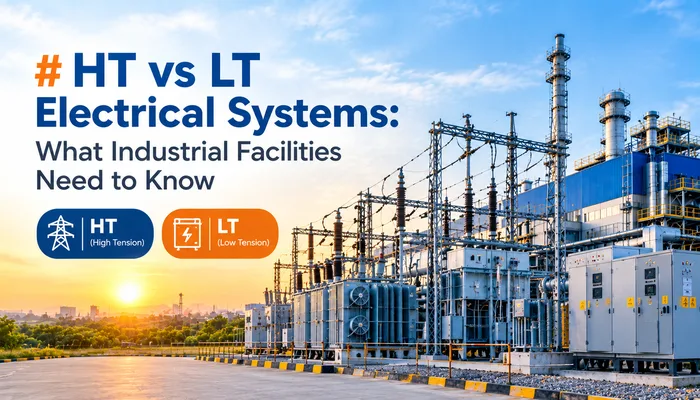
Electricity is one of the most important parts of any industrial facility. From production machinery and motors to lighting, automation systems, and safety equipment, almost every operation depends on a reliable power supply. But industrial electrical systems are not all the same. The way power is received, distributed, transformed, and delivered to equipment depends largely on the facility's requirements.
Two commonly discussed systems are High Tension (HT) and Low Tension (LT). Understanding the difference between them is important when planning a new factory, expanding an existing plant, or upgrading an electrical network.
HT systems are generally associated with higher-voltage incoming supply and primary distribution, while LT systems are used for lower-voltage distribution to equipment and final loads. In Indian electrical practice, the exact regulatory classification of voltage levels should be checked against applicable Central Electricity Authority requirements and the relevant utility requirements.
For industrial projects, the right approach is not simply about choosing HT or LT. It involves proper load assessment, electrical design, transformer selection, protection, cabling, earthing, installation, testing, and commissioning.
What Is an HT Electrical System?
HT stands for High Tension and generally refers to the higher-voltage side of an industrial power distribution system. In a typical industrial facility, electricity may enter the site at a higher voltage before being stepped down through a transformer for use by machines and other equipment.
An HT system can include incoming lines, HT switchgear, protection equipment, transformers, cables, metering arrangements, and associated safety systems.
Because higher voltages require specialised equipment and safety procedures, HT work should be planned and executed by experienced professionals. Depending on the project, the work may include route surveys, line erection, cable installation, transformer connections, earthing, testing, and commissioning.
This is where an experienced HT LT Electrical Contractor can help coordinate different parts of the electrical infrastructure instead of treating each activity as a separate job.
What Is an LT Electrical System?
LT stands for Low Tension and generally refers to the lower-voltage distribution side of an electrical installation. After power passes through a transformer, it is distributed through LT panels, cables, feeders, and other equipment to supply industrial loads.
LT systems are commonly used for machinery, motors, lighting, control equipment, HVAC systems, and other electrical loads within a facility.
The design of an LT network depends on factors such as connected load, demand, cable length, equipment ratings, voltage drop, short-circuit levels, and future expansion requirements.
A properly designed LT system helps distribute power safely and efficiently throughout the plant.
HT vs LT: What Is the Main Difference?
The simplest way to understand the difference is to look at where each system operates in the power distribution process.
| Factor | HT System | LT System |
| Main purpose | Incoming and primary power distribution | Distribution to final industrial loads |
| Typical equipment | HT panels, switchgear, transformer, protection systems | LT panels, feeders, MCCs, distribution boards |
| Voltage | Higher-voltage side | Lower-voltage side |
| Application | Large industrial power distribution | Machinery and internal plant distribution |
| Installation | More specialised | Generally simpler, but still requires proper engineering |
| Safety | Requires strict high-voltage safety procedures | Requires appropriate protection and electrical safety measures |
| Maintenance | Requires specialised inspection and testing | Requires routine inspection, testing, and maintenance |
The actual voltage level, supply arrangement, and regulatory requirements depend on the project and local electricity utility. CEA regulations and technical standards provide the broader regulatory framework for electrical construction and safety in India.
HT Line Erection in Industrial Projects
For facilities receiving power through an HT connection, line infrastructure must be properly planned before installation begins.
HT Line Erection can involve activities such as route surveying, pole or structure erection, conductor or cable installation, insulator fitting, equipment connections, earthing, and testing.
The quality of HT line installation directly affects the reliability and safety of the overall electrical system. Incorrect alignment, inadequate clearances, poor connections, or improper earthing can create operational and safety problems.
Therefore, HT line work should be carried out according to the approved design, applicable technical standards, utility requirements, and project-specific safety procedures.
LT Line Erection and Distribution
Once power has been stepped down, it needs to be distributed throughout the facility. This is where LT Line Erection and LT distribution work become important.
LT distribution may include cables, feeders, panels, support structures, cable trays, and connections to different sections of the plant.
During installation, engineers need to consider the expected load and cable capacity. Proper cable sizing is particularly important because undersized cables can lead to excessive voltage drop, overheating, energy losses, and premature failure.
A well-planned LT network should also allow convenient maintenance and provide sufficient flexibility for future plant expansion.
Role of Transformers in HT and LT Systems
The transformer is one of the key links between HT and LT systems. It changes the voltage level so that electrical power can be distributed and used by industrial equipment.
For example, an industrial facility may receive power at a higher voltage and use a transformer to step it down to a suitable lower voltage for internal distribution.
The transformer selection should be based on factors such as connected load, demand, load growth, operating conditions, transformer type, efficiency, and installation environment.
Professional Transformer Installation Services typically involve more than simply placing the transformer at the site. The installation may include positioning, connections, earthing, protection arrangements, testing, and commissioning.
Power Transformer Installation
Power Transformer Installation requires careful planning because transformers are major electrical assets. The installation area should provide appropriate access, ventilation or cooling arrangements, clearances, protection, and maintenance space as applicable to the transformer type.
Connections between the transformer and associated HT/LT equipment must also be properly designed and installed.
Testing before energisation is an important part of the commissioning process. The specific tests required depend on the transformer type, rating, project specifications, and applicable standards.
Distribution Transformer Installation
Distribution Transformer Installation is commonly required where electrical power needs to be stepped down for distribution to a facility or particular load area.
The installation should consider transformer capacity, incoming and outgoing connections, protection, earthing, physical location, accessibility, and future maintenance requirements.
Correct transformer sizing is especially important. A transformer that is too small may struggle with the expected load, while an unnecessarily oversized transformer can increase project costs and may not operate as efficiently as intended under all conditions.
HT and LT Systems in Industrial Electrical Installation
A complete Industrial Electrical Installation involves much more than connecting cables and equipment. It starts with understanding the facility's electrical requirements and continues through design, equipment selection, installation, testing, and commissioning.
A typical industrial electrical project may include:
- Load assessment and electrical calculations
- Single Line Diagram (SLD) preparation
- HT incoming supply arrangements
- Transformer installation
- HT and LT cable laying
- LT distribution panels
- Earthing systems
- Electrical protection
- Equipment connections
- Testing and commissioning
The objective is to create an electrical network that can support present operations while also allowing practical expansion in the future.
Why Factory Electrification Needs Proper Planning
A factory may have different types of electrical loads operating simultaneously. Motors, production machinery, compressors, pumps, lighting, control systems, and other equipment can all place different demands on the electrical network.
This makes Factory Electrification Services an important part of industrial project planning.
Good planning should consider:
- Present connected load
- Expected maximum demand
- Future expansion
- Transformer capacity
- Cable sizing
- Panel capacity
- Voltage drop
- Protection coordination
- Earthing
- Equipment location
- Maintenance access
Poor planning at the beginning can create problems later. For example, insufficient transformer capacity or limited panel space can make future expansion expensive and complicated.
Plant Electrification: From Incoming Supply to Machinery
Large manufacturing facilities often require a coordinated approach to electrical infrastructure. Plant Electrification Services can cover the complete power distribution system from incoming supply through transformation and internal distribution.
A typical power flow can be understood as:
Incoming HT Supply → HT Equipment → Transformer → LT Main Panel → Distribution Panels → Machinery and Other Loads
Each stage needs to work correctly with the next. An issue at one point can affect the reliability of the entire system.
For this reason, industrial electrical planning should not treat HT, transformers, LT distribution, and equipment connections as completely separate activities.
Why Choose an Experienced Industrial Electrical Contractor?
Industrial electrical work involves high-value equipment, complex distribution networks, safety requirements, and production-critical systems. Working with an experienced Industrial Electrical Contractor can help ensure that different stages of the project are properly coordinated.
A professional contractor may manage activities such as:
- Electrical system planning
- HT/LT line work
- Transformer installation
- Cable laying and termination
- Panel installation
- Earthing
- Testing
- Commissioning
- Coordination with relevant authorities and utilities
The contractor's role should be clearly defined according to the project's scope, specifications, applicable regulations, and client requirements.
What to Consider When Selecting an Electrical Installation Contractor
Choosing an Electrical Installation Contractor should not be based only on the quoted project price. Industrial electrical infrastructure is a long-term investment, so technical capability and project execution experience are also important.
Before appointing a contractor, businesses should consider:
1. Relevant Project Experience
Check whether the contractor has handled projects similar in size, electrical load, industry, and complexity.
2. Technical Capability
The contractor should have the required engineering knowledge and manpower to handle the project's electrical scope.
3. Safety Practices
Electrical work requires proper safety planning, trained personnel, suitable PPE, isolation procedures, and appropriate site controls.
4. Testing and Commissioning
Installation is not complete when equipment is physically connected. Testing and commissioning are essential before the system is put into normal operation.
5. Documentation
Electrical drawings, test reports, equipment information, inspection records, and other relevant documentation should be properly maintained.
Electrical Installation Services for Industrial Facilities
Professional Electrical Installation Services can help businesses manage the different stages of an industrial electrical project under a coordinated execution plan.
Depending on the project scope, these services may include HT/LT line work, transformer installation, cable laying, industrial electrification, panel installation, earthing, testing, and commissioning.
The exact scope should always be based on the facility's electrical requirements and approved engineering design.
For industrial facilities planning a new installation or plant expansion, it is useful to evaluate the complete electrical system rather than focusing on a single component. HT supply, transformer capacity, LT distribution, protection, cabling, and future load requirements should all be considered together.
Final Thoughts
HT and LT systems perform different but connected roles in industrial power distribution. HT systems handle higher-voltage incoming and primary distribution, while LT systems distribute power to the equipment and loads within the facility. A reliable industrial electrical network depends on how effectively these systems work together.
From HT Line Erection and LT Line Erection to transformer installation, cabling, factory electrification, and final commissioning, every stage requires proper planning and execution. Selecting the right Industrial Electrical Contractor and Electrical Installation Contractor can help businesses build an electrical infrastructure that supports safe operation, reliable power distribution, and future growth.
With experience in industrial and infrastructure electrical projects, Sahjanand Engicon provides integrated electrical solutions covering HT/LT line work, transformer installation, industrial electrical installation, factory electrification, and related electrical infrastructure requirements.