
RCC Box Culvert Construction: Process, Types and Applications
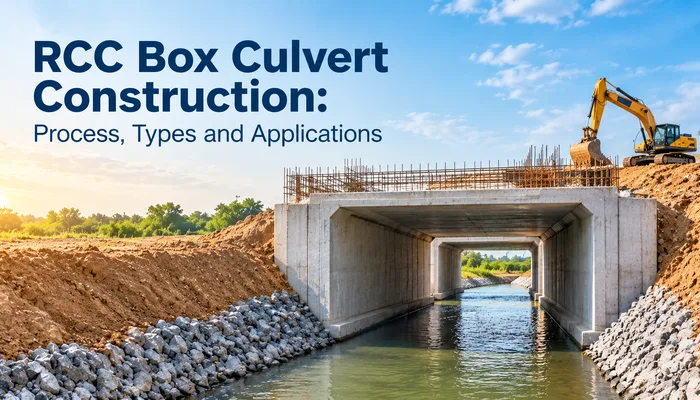
Proper drainage is an essential part of road development, industrial infrastructure, railway projects, and urban construction. Without an effective drainage system, rainwater can accumulate near roads, weaken foundations, damage surrounding structures, and interrupt daily operations. One practical solution is an RCC box culvert, which allows water to pass safely beneath roads, railway tracks, embankments, and other infrastructure.
RCC Box Culvert Construction involves building a strong reinforced concrete structure that can withstand soil pressure, traffic loads, and environmental conditions. These structures are commonly used where water needs to cross beneath a road or where a drainage channel must pass through an embankment.
What Is an RCC Box Culvert?
Every road, railway line and industrial estate eventually meets water. Streams, canals and monsoon runoff have to cross the structure somewhere, and how that crossing is built decides whether the infrastructure lasts years or decades. This is where RCC Box Culvert Construction matters.
An RCC Box Culvert is a closed rectangular conduit made of steel-reinforced concrete. It carries water under an embankment, road or rail track. A reinforced concrete box culvert has a top slab, a bottom slab and two side walls, all acting as one rigid frame. That shape spreads the load evenly in every direction. It handles heavy traffic and soil pressure from above, and strong water flow from within.
Round pipes work for small flows. When the discharge is larger, the cover over the structure is shallow, or the ground is soft, a box section is usually the better choice. Its flat base also gives a more stable footing on weak soil.
Why Box Culverts Are Preferred for Drainage
Engineers choose box culvert construction over other crossing methods for practical reasons:
- High load capacity: The monolithic frame carries highway, railway and industrial loads without excessive deflection.
- Large flow area: A rectangular opening moves more water than a pipe of similar height.
- Long service life: Properly cured, well-compacted concrete resists weathering, abrasion and chemical attack for decades.
- Low maintenance: There are no moving parts, and inspection and desilting are simple.
- Flexible sizing: Single-cell, double-cell and multi-cell sections can be designed for almost any discharge.
Good drainage construction services use these strengths to keep flood water away from roads, plants and residential areas. A well-placed culvert can protect an entire project from waterlogging.
Types of Box Culverts
Box culverts are classified by how they are built and how many openings they have.
Cast-in-situ box culverts. The concrete is poured at the final location, inside shuttering built on site. This method suits irregular alignments, skewed crossings and large sections that are hard to transport. It takes longer, since the concrete needs time to gain strength, but it gives a seamless structure.
Precast box culverts. The units are manufactured in a controlled yard, cured under proper conditions and then lifted into place. Quality is more consistent, and installation is much faster. This helps on live highways and railway sections where the shutdown window is short.
By number of cells. A single-cell culvert has one opening, a double-cell has two, and a multi-cell has three or more. The choice depends on the design discharge, the available waterway width and the permitted height.
Contractors who offer both methods can pick whichever suits the site, schedule and budget.
The Box Culvert Construction Process
The box culvert construction process follows a clear sequence. Skipping or rushing any stage usually shows up later as cracks, leakage or settlement.
1. Survey and design coordination.
Work starts with a topographic survey, a hydrological study and a soil investigation. These fix the flow rate, the invert levels, the alignment and the bearing capacity of the ground. The structural design is then checked against the applicable loading standards, such as IRC loading for roads or railway loading for tracks.
2. Excavation and site preparation.
The trench is excavated to the design level and width. If water is present, it is diverted or pumped out so the work can proceed in dry conditions. The formation level is trimmed, checked and compacted to give a firm base.
3. PCC bed.
A layer of plain cement concrete, commonly called PCC, is laid as a levelling course. It keeps the reinforcement clear of the soil and gives a clean, flat surface for the main slab.
4. Reinforcement steel fixing.
Steel bars are cut, bent and tied exactly as the bar-bending schedule specifies. Spacing, laps, anchorage and concrete cover are critical here. Cover blocks maintain the required distance from the formwork so the steel stays protected from moisture.
5. Formwork.
Shuttering is erected for the base slab, walls and top slab. It has to be rigid and tight enough to resist concrete pressure without bulging or leaking. Well-built formwork also gives a smooth finish and accurate dimensions.
6. Concrete casting.
The mix is designed for the required grade and workability. It is placed in layers and compacted with vibrators to remove air pockets. Construction joints, where unavoidable, are planned in advance and treated properly so they do not become leakage paths.
7. Curing.
Curing is often neglected, yet it decides the final strength and durability. Keeping the concrete moist for the specified period prevents shrinkage cracks and lets the structure reach its design strength.
8. Waterproofing and backfilling.
Once the concrete has gained adequate strength, the exterior surfaces are treated. Backfilling is then done in thin layers with selected material, compacted evenly on both sides of the culvert. Uneven backfilling can push the walls unevenly, so this step needs close supervision.
9. Testing and handover.
Quality tests such as cube strength, level checks and visual inspection confirm that the work meets the drawings and specification. Wing walls, aprons and protective works are completed, and the structure is handed over with documentation.
Precast vs. Cast-in-Situ: Choosing the Right Method
There is no single best answer. For RCC culvert construction on a new road in open country, cast-in-situ is often economical and flexible. On an operating railway line or a busy highway, precast units shorten the working window and reduce disruption. Site access, crane availability, transport distance, soil conditions and the project timeline all influence the decision. An experienced contractor will weigh these factors before recommending a method rather than defaulting to one.
Applications of RCC Box Culverts
Box culverts appear in a wide range of projects:
- Highways and rural roads: Allowing streams and drainage channels to pass beneath the carriageway.
- Railway embankments: Carrying cross-drainage under tracks where settlement tolerance is very low.
- Industrial parks and factories: Managing storm water and process drainage inside large campuses.
- Smart city and urban projects: Handling stormwater in congested areas where open drains are impractical.
- Irrigation and canal crossings: Moving water under access roads and farm tracks.
- Utility corridors: Providing protected passage for cables and pipelines in some installations.
In each case, the culvert is a small part of the total cost but a critical part of the total performance.
Quality Practices That Make a Difference
Durable culverts come from consistent site discipline more than from any special material. A few practices stand out:
- Approved mix designs and regular cube testing for every pour.
- Correct bar spacing, cover and lap lengths, verified before concreting.
- Proper vibration to avoid honeycombing.
- Adequate curing, recorded day by day.
- Layered, well-compacted backfill with moisture control.
- Safe working methods during excavation near water and traffic.
Owners should also ask whether the contractor can manage related work such as foundations, steel fabrication and electrical infrastructure. A single team handling several packages reduces coordination gaps and delays.
Why Work with a Full-Service Contractor
Culverts rarely exist in isolation. They sit inside larger projects involving earthwork, foundations, structures and utilities. Choosing a turnkey contractor brings design coordination, procurement, construction, testing and handover under one point of responsibility. That means fewer interface disputes and clearer accountability. Dependable engineering services also help with documentation, inspection records and compliance with project specifications, which clients and authorities increasingly expect.
Conclusion
A well-built culvert is easy to overlook. It sits quietly below the surface for decades, moving water without incident. That reliability comes from careful surveying, sound design, disciplined site execution and proper curing. Whether the project calls for precast or cast-in-situ units, each stage of the process needs equal attention.
Sahjanand Engicon LLP, an Ahmedabad-based turnkey contractor, delivers RCC Box Culvert Construction from survey and design coordination through construction, quality testing and handover. Its capabilities also include drainage structures, RCC foundations, steel fabrication and complete factory setup. For clients who want durable, cost-effective box culvert construction with one accountable team, Sahjanand Engicon LLP offers the engineering depth and project management to deliver it.